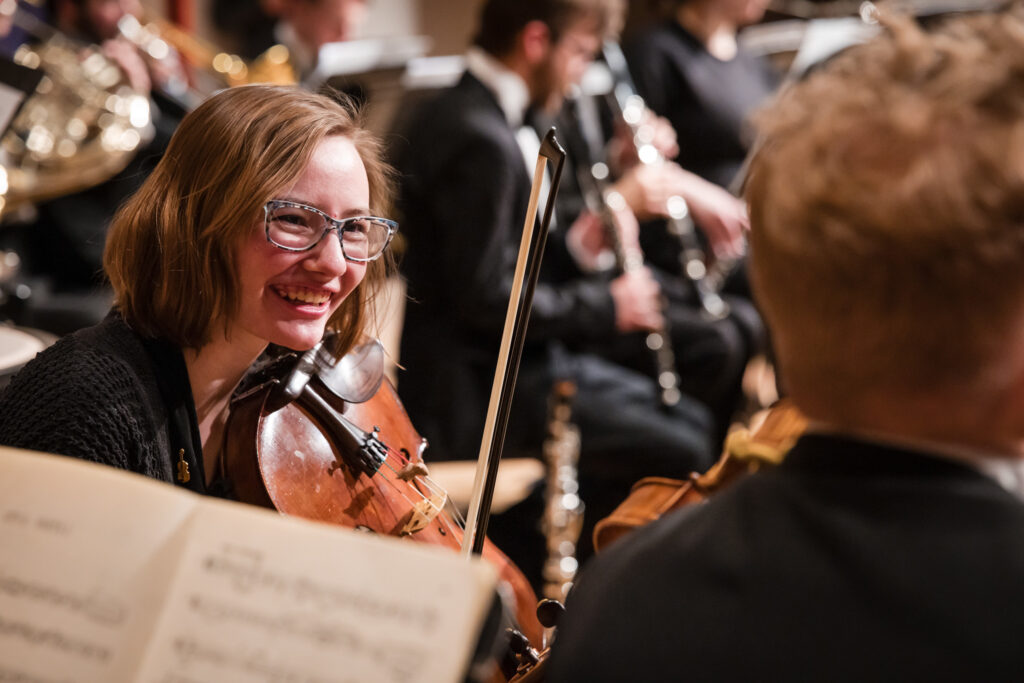
Teaching has always been a part of music education major Emily Mullen’s life. A lifelong educator, she taught her first private lesson at the age of nine, and recently began working as a student teacher during her final semester at Shenandoah Conservatory. But after nearly 20 years of devotion to the violin and viola, she says her favorite part of teaching is not the subject, but rather, the connections made along the way.
Mullen first crossed paths with the Richmond Symphony School of Music in 2022, when she participated in the second annual Future Music Educators Symposium (FMES) as a senior in high school. Each spring, FMES welcomes high school juniors and seniors from across the state of Virginia to participate in an 8-week online seminar focusing on the career of music education. Throughout the semester, students participate in workshops and classes where they develop and strengthen new and existing teaching skills.
Acceptance into FMES follows a highly selective application process. The first step is completed not by the students participating, but rather, their own music teachers. Teachers who know a high school junior or senior with the passion and potential to be a music educator first place a nomination directly through the Richmond Symphony School of Music; then, eligible students are sent the official application. Through this inverted application process, it is the music teacher’s faith and confidence in the student that makes them eligible to participate. For Mullen, that person who believed in her so dearly was Ginger Paris, strings director in Lynchburg City Schools and Mullen’s very first teacher.
Mullen started studying violin with Paris at the age of four through Lynchburg City Schools’ strings program—notably the only school program in the state that offers both free violin lessons to all students in kindergarten through grade five in addition to orchestra classes to grades six through twelve. It was in Paris’s elementary school classroom that Mullen took her first steps as a music teacher, helping teach younger students both during the school year and during Lynchburg City Schools’s summer music camps. She even taught her first private lesson under Paris’s guidance—an experience that Mullen described as “really impactful” for her then-fourth-grade self.
Equally impactful was Paris’s choice to nominate Mullen for FMES. When she received the email with Paris’s recommendation and her official invitation to apply for the symposium, Mullen—then a high school senior—was at a crossroads in her life.
“At the time, I was planning to go into atmospheric sciences and astrophysics to do space meteorology, but I’d always loved teaching. … I didn’t [originally] want to go into music as a career because I was worried I would hate it,” Mullen said—a scarily real possibility for any young musician intending to make it their livelihood.
As the college application process progressed and Mullen grew closer to graduating, she knew she had to take the chance and give a career in music education a try.
“I just kind of got to a point where I couldn’t see myself doing anything else,” Mullen said. “It made so much more sense to go into music and just see what happened rather than automatically shutting it out.”
Paris’s nomination confirmed to Mullen that she was making the right choice. “I’d already kind of cemented that I was switching towards music ed,” Mullen said, “and then [the nomination] helped solidify it.”
And with that, Mullen began the next step in the application process. Weeks later, she heard the good news: she was officially invited to join that year’s symposium, and in February 2022, the first classes of the year began.
At the start of a semester in FMES, classes are led by Dr. Sandy Goldie, Chair of the Department of Music and Director of Music Education at Virginia Commonwealth University’s School of the Arts. Subsequent classes welcome guest educators from across the Commonwealth, ranging from elementary teachers to university professors.
“It was impactful to see all of the guests that they brought in throughout the course,” Mullen said. “It opened my eyes that there were so many alternate careers in the music ed realm that I had never considered, like being a fine arts coordinator or [working] with symphonies.”
Towards the end of their time in the program, students present a project reflecting on the knowledge gained from the semester, which Mullen cites as her favorite part of the course. Her project of choice was to teach her father how to play the violin. Together—with her father on violin and Mullen accompanying on viola—they performed a rite of passage for beginning string musicians: the classic Twinkle, Twinkle, Little Star.
Just a few short months after her time in FMES, Mullen graduated from both E.C. Glass High School and Central Virginia Community College, where she earned an associate’s degree in arts and sciences. Two degrees in hand, she moved to Winchester and prepared for her first year at Shenandoah Conservatory.
During her first seven semesters as a student at Shenandoah, Mullen’s coursework included both the usual music major fare—classes in music theory, history, and performance—as well as a sequence of education-specific coursework. Notably, music education majors learn how to play instruments from every instrument family—strings, woodwinds, brass, percussion, and voice, equipping them to teach any level of any K –12 ensemble. Mullen’s coursework also included field placements at local schools, where she shadowed music teachers at the elementary, middle, and high school levels.
Mullen has been equally devoted to the field of music education outside of her classes, working with a number of community arts organizations. In the summer of 2024, she began an internship with the Shenandoah Conservatory Arts Academy, working in the fields of community engagement and arts administration. There, she has assisted with event coordination, community advocacy, and data management.
Mullen has also worked extensively with the Virginia Music Educators Association (VMEA). As a freshman, she served as first-year representative of Shenandoah’s chapter of VMEA; in 2025, she was elected president of the state’s full collegiate chapter (CoVMEA). At annual conferences, she was able to connect in person with students from other collegiate chapters, which, after a year of online meetings, Mullen described as “so, so special.”
“It makes me really, really confident and excited for the future of music education,” Mullen said. “We have some really solid people entering the field in the next few years. … There’s so much passion and excitement and hope out there.”
Additional advocacy work with VMEA has taken Mullen nationally. For two years, she has participated in the Hill Day event facilitated by the National Association for Music Education (of which VMEA is a state chapter). In this annually occurring event, music educators from across the country visit Capitol Hill in Washington, D.C. to speak to legislators and advocate for improvements within the industry. Mullen has participated in Hill Day for two years now, advocating directly to Virginia state legislators alongside peers from Shenandoah and other representatives from VMEA. Seeing the legislative process firsthand has been “transformative,” Mullen said.
During Mullen’s eighth semester at Shenandoah, she began the final portion of her degree: two student teaching placements, each spanning an eight-week period. For her final semester, she will take on the role of a full-time music teacher, supervised by the cooperating teacher at each of her placements.
The first of Mullen’s two student teaching placements began this January. Her current position is at Frederick Douglass Elementary School in Frederick County, where she helps teach general music to students ages 3 through 10. Mullen is able to specialize her music teaching skills further through work with the school’s English-Spanish immersion program and special education department. In March, she will transition to Taylor Middle School and Kettle Run High School, both in Fauquier County. There, she will student teach middle and high school orchestra.
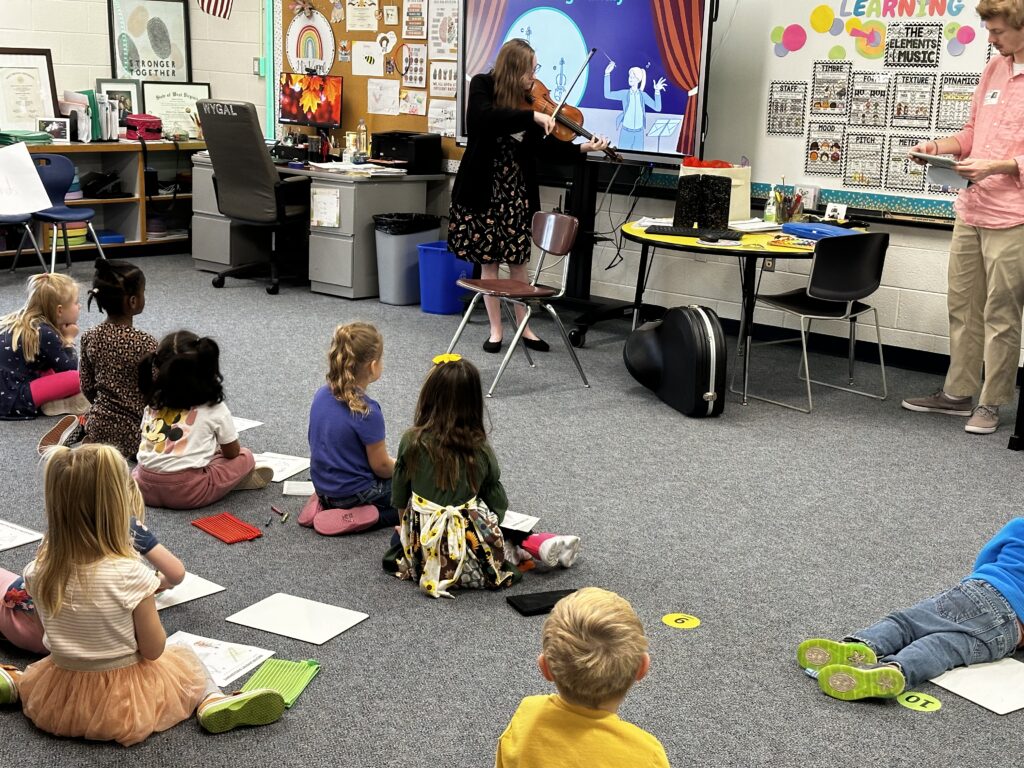
Being able to work with such a wide range of ages is “really, really special,” Mullen said. “It’s so fun. The kids are so happy. [Frederick Douglass] is so supportive and the community is really great there, which helps a lot. … Genuinely it’s been the highlight of my life.”
Upon completion of her student teaching fieldwork, Mullen will graduate with a Bachelor of Music in Music Education and will be eligible to apply for a Virginia teaching license. Though she’ll have another degree under her belt, she’s not yet done learning—Mullen is currently applying to graduate programs in the field of musicology (the academic study of music).
In graduate school, Mullen plans to integrate her love for music education with her passion for American history. The first music school (located in Boston, Massachusetts) was established by educator Lowell Mason in 1832; just under 30 years later, the Civil War began. “I’m really interested in exploring the connections there,” Mullen said, “as well as the modern connections of education and music. In the meantime, Mullen will spend her summer at Gettysburg National Military Park, where she will work with their Division of Interpretation and Education. This will be her second year interning at the park.
With years of teaching ahead of her, Mullen looks back fondly to her time as a senior in high school and her time in FMES, when she officially decided to pursue a career in music education.
During our interview, Mullen pulled out a notebook from 2022, which housed a semester’s worth of symposium notes. Through almost four years of collegiate music education and countless teaching placements, jobs, and internships, she’d held on to her notes from the symposium. “I’m actually still in contact with the large majority of my classmates from the symposium,” Mullen noted, flipping through the notebook to recall memories from high school. “We see each other at VMEA. We still have our group chat from the program.”
Though she of course loves classical music, for Mullen, the best part of being a music teacher isn’t the field of study—it’s the people you connect with, Mullen says, from the students to the teachers and all the others you meet along the way.
“Teaching genuinely boils down to the people you are working with, not exactly what you are teaching,” Mullen said. “At the end of the day, it’s [all about] the human beings we are working with, and that’s what makes this career and this vocation and this calling so impactful.”
Nominations for next year’s Future Music Educators Symposium (FMES) will open in fall 2026. To learn more about FMES, click here. For inquiries, contact Marcey W. Leonard, Assistant Director of Community Partnerships, at mleonard@richmondsymphony.com.
Our monthly Spotlight Series is written by Anna Mitchell, Education & Social Media Coordinator. For inquiries, contact education@richmondsymphony.com.